
Six Red Flags in a Luxury Fragrance Manufacturer's Pitch
Premium positioning is the easiest claim to make in fragrance manufacturing, because most of it is invisible from the outside. A heavier bottle and a higher number on the label can be arranged by anyone. The warning signs are therefore not about the product a supplier shows you, but about how the supplier responds when asked for evidence: which documents exist, who owns quality, what happens to a batch that does not match, and whether the premium claim survives being written down. Brands that test the claim in the first two conversations save themselves a reformulation later.
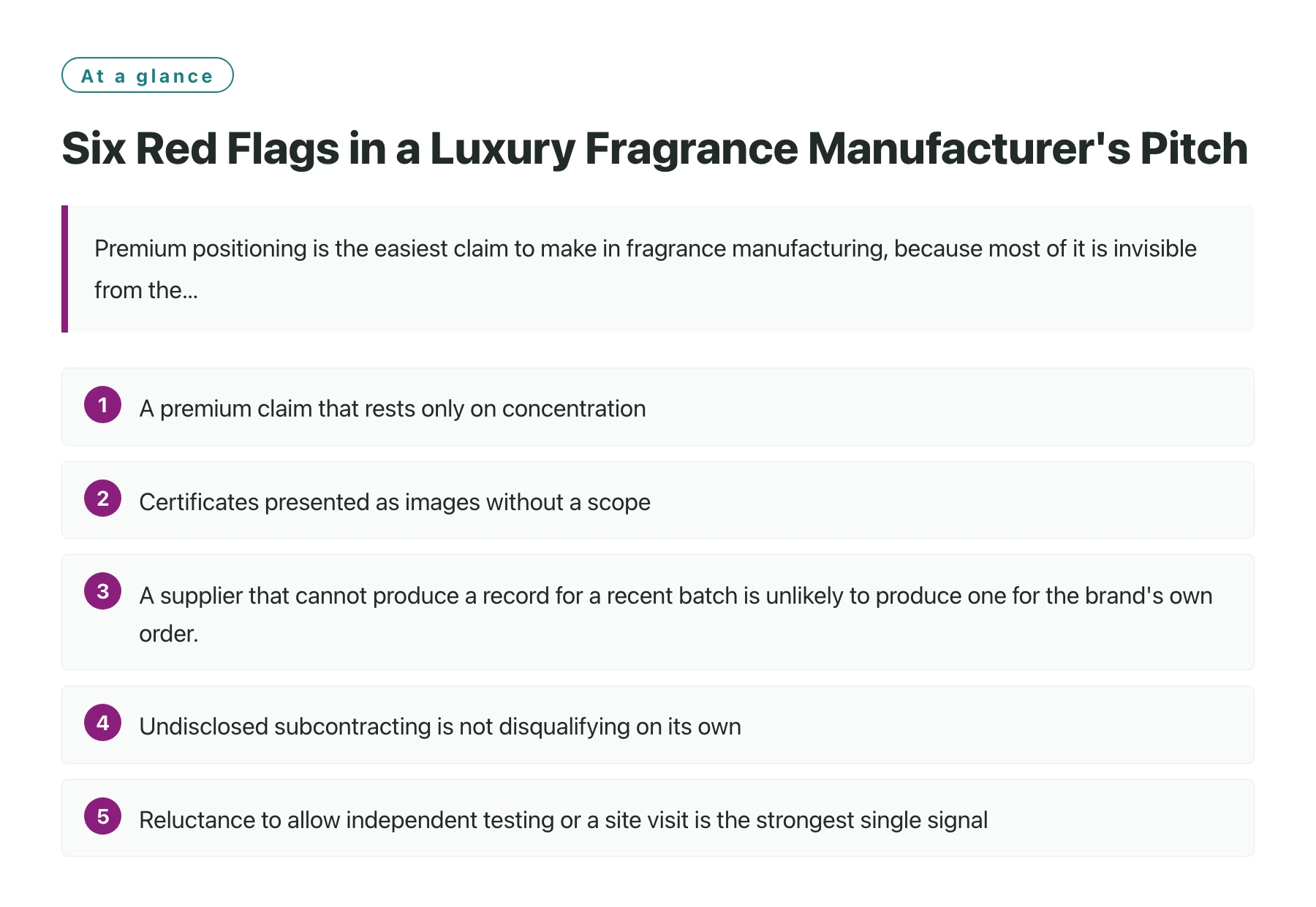
Key takeawaysA premium claim that rests only on concentration, bottle weight or price is a positioning statement rather than a manufacturing capability. · Certificates presented as images without a scope, issuing body and certificate number are decoration, not evidence. · A supplier that cannot produce a record for a recent batch is unlikely to produce one for the brand's own order. · Undisclosed subcontracting is not disqualifying on its own, but it must be named, because responsibility for a defect follows the process, not the contract. · Reluctance to allow independent testing or a site visit is the strongest single signal, because both are normal requests from a serious buyer.
Most supplier pitches are honest. The problem is that they are also optimistic, and premium is the area where optimism costs the most, because premium work is where a small process gap becomes a visible product defect.
This is a list of signals rather than accusations. Each one describes something that could have an innocent explanation, and each one deserves a question. A supplier with real premium capability answers those questions easily, because the answers are sitting in its records already.
The six signals, and the question that tests each one
| Red flag | Why it matters | What to ask instead |
|---|---|---|
| Premium is defined by the label or the price | Concentration and price describe position, not materials or process control | Which materials in this compound carry the premium, and what grade are they |
| The quality function has no name | Someone has to own the standard, and an unowned standard drifts | Who signs off a batch, and can I speak to that person before ordering |
| Certificates are shown but not scoped | A certificate covers a site, a scope and a period, and the details decide whether it applies to your product | Please send the certificate number, issuing body, scope and expiry date |
| No recent batch record is available | Records are the only way a disagreement about a delivered batch is settled | Show me the record for one batch shipped in the last six months |
| Stages of the work are undisclosed | If compounding, filling or finishing is subcontracted, the brand needs to know where each stage happens | Which steps are done on this site, and which are done elsewhere |
| Independent testing or a visit is discouraged | Both are ordinary requests, and resistance usually indicates something the supplier would rather not have examined | Which third-party laboratory do you use, and when can we schedule a visit |
Read the third column as the real deliverable. Each question produces either a document or a hesitation, and both are useful information.
Why premium failures look different from ordinary ones
A mid-market product can survive a small inconsistency, because the buyer's expectation is calibrated to the price. A premium product cannot, because the customer who pays more notices more. The characteristic premium failures are subtle: a note that sits slightly lower than the approved sample, a crimp that is a millimetre off on part of the run, a spray that is heavier on one in fifty units, a bottle whose coating is uneven under a certain light.
Those failures come from process discipline rather than from materials. That is why the red flags below matter more for a premium claim than for a volume order: the brand is paying for control, and control has a paper trail.
Materials matter too, and the honest version of that claim is specific. A higher dose of a costly material, a defined grade, a longer resting period and a base that holds together after several hours are all describable. A supplier that can name them is describing a formulation; a supplier that answers with adjectives is describing a mood.
Compliance follows the same logic. Restricted materials have limits that depend on the product category and the concentration used, so a premium claim that ignores those limits is a claim that will meet a wall during documentation [1]. Asking how the supplier handles a restricted material in a high-dosage formula is a fast way to find out whether the compliance work is real.
What a good answer sounds like
A named quality owner with the authority to reject a batch. A certificate with a scope that matches the product and an expiry date in the future. A batch record that can be retrieved in minutes and compared against a retained sample. A clear statement of which stages happen on site and which do not. A laboratory relationship that the supplier can describe without prompting, including what it sends out and why [2]. Some of that material can be gathered before a call even takes place, from what a supplier publishes about its own fragrance production Xuelei fragrance production, and reading it first makes the questions sharper.
Safety assessment is worth a separate question, because high-dosage premium work is where the margin between a beautiful accord and a defensible one is narrowest. Fragrance materials are evaluated for skin exposure and some carry use restrictions, so the brand should hear how the supplier checks the finished product against those limits rather than assuming that a premium brief is automatically compliant [3].
The most reassuring answer of all is a willingness to be wrong. A supplier that says a specific claim cannot be met at the brand's price, and explains what it would take, is more useful than one that agrees to everything. The first behaviour is what a real premium programme looks like; the second is what a difficult first delivery looks like.
Use the first call to collect questions, not answers
The most efficient way to run a first call with a candidate is to spend it identifying what needs to be checked, and to send the questions in writing afterwards. Written questions produce written answers, and written answers can be compared between suppliers, which is impossible with recollections of a call.
It also changes the balance of the conversation. A supplier who receives a specific list learns that the buyer is serious and organised, which tends to produce the project team rather than the sales team. The published questions that a serious buyer asks a factory are a reasonable starting set, and they are worth adapting rather than reinventing the questions to ask a perfume factory.
Background claims deserve the same treatment. Years in business, markets served and certifications are all checkable, and the version that survives checking is more valuable than the version that sounds impressive its background and certifications. A brand that verifies the background once can then spend its attention on the product.
One habit that catches most of these problems early: ask every candidate the same five written questions and keep the replies in a single document. The supplier that answers in specifics will stand out immediately, and so will the one that answers in adjectives.
Sources
- IFRA Standards Library (International Fragrance Association) —— The IFRA Standards Library lists the restrictions the fragrance industry applies to individual fragrance ingredients, based on safety assessments; it is the reference point for compliant fragrance formulation.
- SGS: Cosmetics, Personal Care & Household Testing —— Testing, inspection and certification services for cosmetics and personal care, including microbiological, stability and safety testing aligned with cosmetics GMP.
- EU Scientific Committee on Consumer Safety (SCCS) —— The EU scientific committee that issues opinions on the safety of cosmetic ingredients, including fragrance allergens and their labelling thresholds.
Frequently asked questions
Is it a red flag if a manufacturer does not own its own perfumery?
Not by itself. Many suppliers work with external perfumers and produce excellent products. It becomes a problem when the arrangement is not disclosed, because the brand cannot then judge who is responsible for a formulation decision.
How many certifications should a premium manufacturer hold?
The number matters less than the scope. One certificate whose scope covers the product and the site is worth more than five whose relevance cannot be established. Ask for the issuing body, the number and the expiry date for each.
Should I insist on a site visit before ordering?
For a premium programme, yes. A visit does not prove quality, but a refusal to allow one removes the only direct evidence a brand can gather, and that asymmetry is worth treating as a signal.
What if the supplier cannot provide the full formula?
That is common and not automatically a red flag. What should be available is a reproducible specification, a retained reference sample and clear terms for what happens if supply stops. Ask which of those the brand will hold.
How do I test a claim about batch consistency without technical staff?
Ask for the record of one recent batch and one retained sample, then compare the documents against each other. A record that cannot be tied to a physical retained sample is a document without a control behind it.
Ready to design your yard?
Join 312,000+ readers and get our weekly Idea Book — photo-rich plans filtered to your zone, sun, and budget.
Get the Free Idea Book