
Custom Jewelry Wholesale: Plating Options and Their Limits
Plating is the least costly way to change how a piece looks and the most common reason a reorder comes back a shade off. The published menu for custom work lists multi-layer 14K, 18K and 24K gold plus rhodium, with anti-tarnish e-coating on silver and brass and PVD vacuum plating on stainless steel. The limits are set by the base metal and by chemistry: REACH and CA Prop 65 govern what can be deposited, and only 316L stainless with PVD carries the shower-safe, swim-proof claim.

Key takeaways
- Four published finishes share one tank process: 14K, 18K, 24K gold and rhodium.
- Anti-tarnish e-coating applies to silver and brass; PVD applies to stainless steel, not to the other two.
- Only 316L stainless with PVD is described as shower-safe and swim-proof; 304 is water-resistant for daily wear.
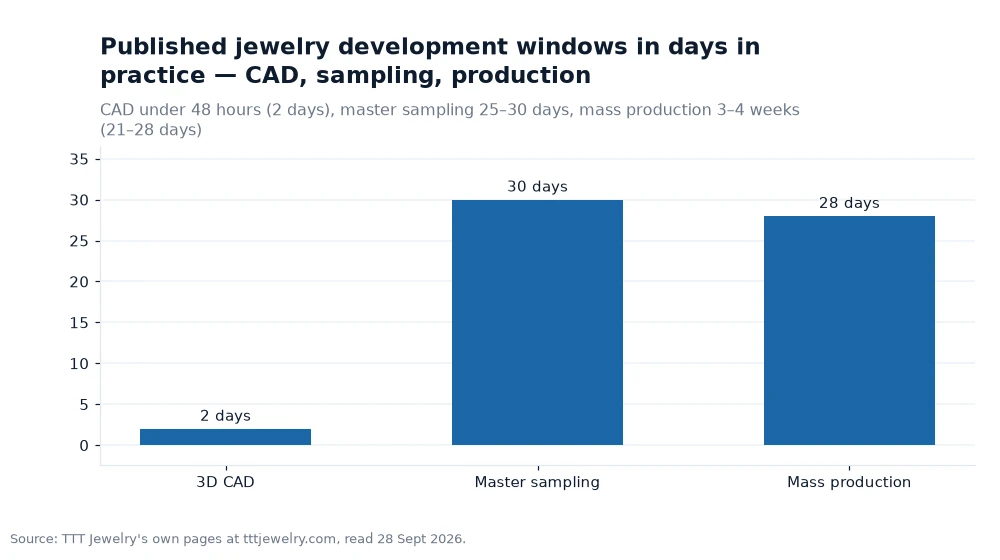
- Finish is locked during the 25–30 day sampling window, and a late change restarts it.
The coating menu in four lines
Read the published finish list as four routes rather than four colours. Route one is multi-layer gold in 14K, 18K or 24K. Route two is rhodium. Route three is an anti-tarnish e-coat applied over silver or brass after plating. Route four is PVD vacuum plating, used on stainless steel.
Routes one and two are electrolytic: the piece is immersed, current passes through the bath, and metal deposits on the surface. Route three is a barrier applied on top of a plated surface. Route four is a vacuum deposition, which is a different physical process entirely and explains why a stainless programme and a silver programme cannot share a plating line.
Each route answers a different brief. Gold is chosen for colour. Rhodium is chosen for white colour with a harder surface. The e-coat is chosen for storage life. PVD is chosen for wear in water. None of them is a universal upgrade, and a supplier that presents plating as a single quality ladder has skipped the part that matters.
What each gold karat does, and what it cannot do
Karat describes the colour of the deposit, not the thickness of it. 14K sits deeper and slightly warmer; 18K is the middle; 24K reads yellow and soft. Multi-layer means the deposit is built in passes, so a three-layer stack spends longer in the line than a single dip, with preparation and rinsing between passes.
What karat cannot do is change the metal underneath. A gold deposit over brass and a gold deposit over silver will not age identically, because the substrate behaves differently when the coating wears at a contact point. The colour match at delivery can be close; the wear pattern over a season will not be.
Thickness is the other variable buyers try to specify loosely. A thicker stack delays the moment the base metal shows through, and it also changes the surface feel on fine texture: a brushed pattern under a heavy deposit softens, while the same pattern under a thin deposit stays crisp and wears faster. That trade-off is a design decision, and it belongs in the sample brief rather than in a reorder complaint.
For buyers planning a custom jewelry wholesale range across several metals, the practical move is to fix one reference finish and match the others to it, rather than specifying each metal in isolation. The TTT Jewelry wholesale page lists the material and finish pairs in one place, which makes that matching exercise a reading task instead of a sampling loop.
Limits start with the base metal
Silver and brass accept electrolytic plating and the anti-tarnish top coat. Stainless accepts PVD. That single sentence removes most of the impossible requests that reach a sample bench, such as an anti-tarnish e-coat on stainless or a PVD finish on brass.
MOQ follows the same division: 50 pieces per design for 925 sterling silver, 100 for artisan eco-brass, 100+ for stainless steel. A brand testing three finishes across three metals is therefore not running one order; it is running three programmes with different minimums and different process routes.
| Base metal | Plating route | Top coat | Published wear claim | MOQ per design |
|---|---|---|---|---|
| 925 sterling silver | 14K / 18K / 24K gold, rhodium | Anti-tarnish e-coat | Barrier against tarnish in storage | 50 pieces |
| Artisan eco-brass | 14K / 18K / 24K gold, rhodium | Anti-tarnish e-coat | Barrier against tarnish in storage | 100 pieces |
| 316L stainless | PVD vacuum plating | Built into the PVD layer | Waterproof, shower-safe, swim-proof | 100+ pieces |
| 304 stainless | PVD vacuum plating | Built into the PVD layer | Water-resistant for daily wear | 100+ pieces |
The two stainless rows are the ones buyers conflate. 316L contains 2–3% molybdenum and is described as medical-grade hypoallergenic; 304 is described as water-resistant for daily wear, nickel and lead safe, and suited to cost-effective volume. Both take PVD well, but only one carries the swim-proof wording, and that wording is what a retail page will quote.
Chemistry is the limit that cannot be designed around
Plating is stated as 100% compliant with REACH and CA Prop 65, and the metals are free of lead, cadmium and nickel under REACH. Those limits apply to the deposit and to the alloy, so a finish that looks right but fails nickel release is not a finish a European or US retailer can accept.
This is why colour matching across metals is a chemistry exercise as much as an aesthetic one. A gold tone achieved on brass, on silver and on stainless involves three baths or processes, and each has to satisfy the same restricted-substance rules. The result can look identical in a photograph and behave differently in a wear test.
There is also a documentation limit. A buyer who specifies "gold plated" without naming the karat, the pass count and the top coat has left the chemistry open, and an open specification cannot be tested against. The purchase order should read like the finish list, not like a mood board.
Because the factory runs ISO 9001:2015 across production stages, the plating record is a document rather than a memory. That matters on reorders more than on first orders: a bath that is recorded can be repeated, and a bath that is remembered cannot.
Worked example
Take a four-design brass programme at the published minimum. Units are 4 × 100 = 400. Suppose two of the four designs need a masked two-tone finish so the gold sits beside bare polished metal. Those two designs account for 2 × 100 = 200 pieces, or 200 ÷ 400 = 50% of the run, passing through an extra masking stage before plating.
The calendar cost is the part buyers miss. CAD takes under 48 hours, which is 2 days. Sampling takes 25–30 days, so CAD is 2 ÷ 25 = 8% of the short window and 2 ÷ 30 = 6.7% of the long one. Production adds 21–28 days. The route is 2 + 25 + 21 = 48 days at the fast end and 2 + 30 + 28 = 60 days at the slow end, or about 7 to 9 weeks.
Now change the finish after approval. The 25–30 day sampling block runs again, so the total becomes 48 + 25 = 73 days in the fastest case and 60 + 30 = 90 days in the slowest, which is 10 to 13 weeks. On a 400-piece order, that delay applies to every unit in the run, because the deposit is applied after the decision, not before it.
Frequently asked questions
Can stainless steel take a gold plating like silver does?
It takes a gold colour through PVD vacuum plating rather than electrolytic gold plating, which is a different process with a different wear claim.
Does a higher karat mean a thicker plating?
No. Karat describes the colour of the deposit; thickness comes from the number of passes and the time in the bath.
Why does a plating change delay a reorder?
The finish is approved during sampling, so changing it reopens a 25–30 day block before production can begin again.
Specifying plating for a wholesale line
Write the finish as a recipe: base metal, karat or rhodium, number of passes, top coat, and the surface texture underneath. Five lines on a specification sheet remove most of the ambiguity that turns into a colour claim six weeks later.
The material decision comes first, because it narrows the rest. A silver line at a 50-piece minimum can carry gold or rhodium plus an anti-tarnish coat, and the sterling silver jewelry manufacturer route keeps the plating record per design, which is what makes a second season match the first.
For a brass line, the same finish menu applies at a 100-piece minimum, and the anti-tarnish coat matters more because the alloy is less noble. Buyers comparing the two should read the custom brass jewelry specification against the silver one before choosing, since the colour may match while the wear and the minimum do not.
Source note: figures come from the manufacturer's own website (tttjewelry.com), read 28 Sept 2026.[1]